USCIS Restores Officer Discretion to Deny Cases Without First Issuing an RFE or NOID
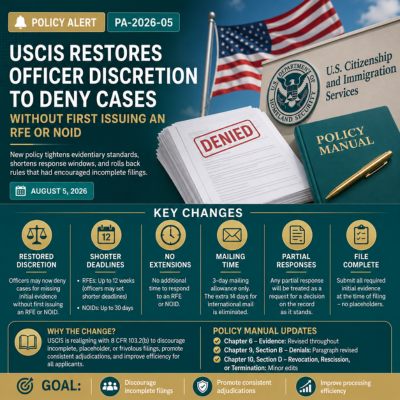
New policy alert (PA-2026-05) tightens evidentiary standards, shortens response windows, and rolls back rules that had encouraged incomplete filings
August 5, 2026
U.S. Citizenship and Immigration Services (USCIS) has issued Policy Alert PA-2026-05, updating the USCIS Policy Manual’s guidance on evidence, Requests for Evidence (RFEs), and Notices of Intent to Deny (NOIDs). The guidance takes effect immediately and applies to any benefit request pending or filed on or after the publication date.
What’s Changing
At the center of the update is a shift in how much latitude officers have to deny a case outright, rather than giving applicants a chance to fix a deficient filing first.
Under the prior policy, officers were generally directed to issue an RFE or NOID whenever a required piece of initial evidence was missing, or when the record on file didn’t establish eligibility. USCIS says that approach was regularly exploited: incomplete or “placeholder” filings could be used to lock in ancillary benefits tied to the pending request, even when the underlying case had little chance of success. It also added to processing backlogs and, USCIS argues, drove up filing fees for everyone by inflating adjudication costs.
The new policy restores officers’ full discretion — already permitted under the governing regulations — to deny a benefit request for failure to meet the burden of proof without first issuing an RFE or NOID, whenever a required piece of initial evidence is missing. Officers may still choose to issue an RFE for the missing evidence rather than deny it outright; the point of the change is that doing so is no longer the default expectation.
A NOID, by contrast, remains the appropriate tool in a narrower set of circumstances: when the applicant did submit all required initial evidence, but that evidence still falls short of establishing eligibility.
Shorter, Stricter Response Windows
The alert also aligns response deadlines more closely with existing regulatory limits:
- RFEs: may not carry a response period longer than 12 weeks. Previously, officers were instructed to default to the full 12-week period as a standard practice; that instruction is being removed. Officers now have discretion to set shorter deadlines.
- NOIDs: response periods remain capped at 30 days.
- No extensions: additional time to respond to an RFE or NOID is not permitted.
- Mailing time: notices sent by mail get a 3-day extension, consistent with regulation. USCIS is eliminating a prior practice of granting an additional 14 days for correspondence mailed outside the United States, which the agency says went beyond what the regulations allow.
Responding to an RFE or NOID
The policy also clarifies how USCIS treats responses that don’t fully answer the request. If a benefit requestor submits any responsive evidence — even if it only partially addresses what was asked for — USCIS will treat that submission as a request for a decision on the record as it stands, rather than holding the case open for further supplementation.
Rationale
USCIS frames the change as a return to the plain terms of the 1994 adjudication regulations (8 CFR 103.2(b)), which give officers discretion — but do not require them — to issue an RFE or NOID before denying a case. The agency states it has not identified significant reliance interests tied to the prior, more lenient approach, and argues that the old policy’s core effect was to invite requestors to file legally insufficient applications with the expectation they could complete the record later.
USCIS says the realignment will:
- Discourage frivolous, placeholder, or substantially incomplete filings
- Promote more consistent adjudications across officers
- Set clearer expectations for what a complete, filing-ready application looks like
- Reduce the unfair advantage gained by applicants who file incomplete requests to secure a priority date or other benefit while still gathering evidence
- Improve overall processing efficiency
Where the Changes Land in the Policy Manual
The update revises three chapters of Volume 1, Part E (Adjudications) of the USCIS Policy Manual:
| Section | Change |
|---|---|
| Chapter 6 – Evidence | Revised throughout; clarifies the distinction between initial and additional evidence, primary and secondary evidence, and the evidentiary weight given to affidavits offered in place of primary or secondary evidence |
| Chapter 9, Section B – Denials | First paragraph under “Denials Based on Lack of Legal Basis” revised |
| Chapter 10, Section D – Revocation, Rescission, or Termination | Minor edits to two paragraphs; final paragraph deleted |
USCIS notes it may also make additional minor technical, stylistic, or conforming edits consistent with this update.
Practical Takeaways for Filers
- File complete. With denial-without-RFE now the restored default posture, submitting all required initial evidence at the time of filing — rather than planning to supplement later — is the safer course.
- Expect shorter clocks. Don’t assume a 12-week response window; officers can and may set shorter deadlines within that ceiling.
- No extensions. Build in buffer time before a deadline, since additional time to respond is not available.
- International mail matters. The extra 14-day buffer for mail sent from abroad is gone; only the standard 3-day mailing allowance applies.
- Partial responses close the door. A partial response to an RFE or NOID will be treated as a request to decide the case as-is, not as an invitation to submit more later.
Source: USCIS Policy Alert PA-2026-05, “Evidence, Requests for Evidence, and Notices of Intent to Deny,” August 5, 2026, updating Volume 1, Part E, Chapters 6, 9, and 10 of the USCIS Policy Manual.
If you have questions about immigration-related issues, file for a new visa or seek specific advice. Ask us now!