The New Form I-129 2026: What’s different for Employers filing H-1B petitions for the Cap Season?
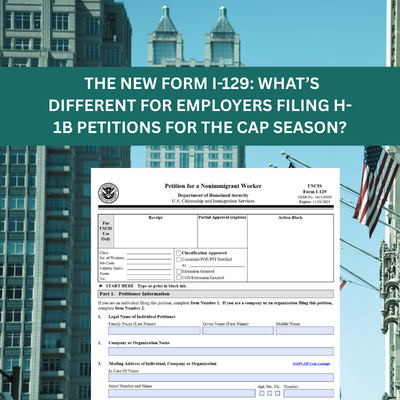
On February 27, 2026, USCIS released a revised Form I-129. The new form aligns with major changes for the FY 2027 H-1B Cap Season. As we all know, the I-129 also applies to other non-immigrant visa petitions, such as L-1 & Q-1, so the new form will apply to those cases as well.
The primary reason behind this introduction
- The primary reason for the latest revision to Form I-129 (edition 02/27/26) is to implement the H-1B Wage-Weighted Selection rule, which replaces the traditional random lottery with a system that prioritizes higher-paid and higher-skilled workers.
- Wage Level Integration: The form now requires specific data to support the new weighted selection process, where registrations are assigned “entries” based on the Department of Labor (DOL) wage level:a. Level IV: 4 entries (highest probability)
b. Level III: 3 entries
c. Level II: 2 entries
d. Level I: 1 entry (lowest probability)
Key Transition Dates
1. Feb 27, 2026:The new edition is now available for use.
2. Through March 31, 2026: USCIS will continue to accept the previous 01/20/25 edition during this grace period.
3. Starting April 1, 2026: USCIS will only accept the 02/27/26 edition. Any filings using the older 01/20/25 edition received on or after this date will be rejected.
To ensure timely and compliant filings, employers should review the new form carefully, update internal procedures, train relevant staff, and monitor official USCIS updates for any additional requirements this cap season may bring.
Which Visa Categories Require Form I-129?
Several common non-immigrant work visa categories require the filing of Form I-129 (Petition for a Non-immigrant Worker), including:
- H-1B Visa – For foreign professionals employed in specialty occupations that require advanced or specialized knowledge, commonly used in the technology, engineering, and healthcare sectors.
- L-1 Visa – Designed for intracompany transferees, enabling multinational companies to transfer managers, executives, or specialized knowledge employees from an overseas office to a U.S. branch.
- O Visa – For individuals who demonstrate extraordinary ability or achievement in fields such as science, arts, education, business, or athletics.
- P Visa – Intended for athletes, entertainers, artists, and essential support personnel entering the U.S. temporarily to participate in specific events, competitions, or performances.
- R Visa – For religious workers seeking temporary employment with qualifying religious organizations in the United States.
- E-1 Visa – For treaty traders engaged in substantial international trade between their home country and the United States.
- E-2 Visa – For treaty investors who have made a significant investment in a U.S. business and are coming to develop or direct that enterprise.
- E-3 Visa – Available exclusively to Australian citizens working in specialty occupations in the United States.
- TN Visa – For eligible Canadian and Mexican professionals entering the U.S. under the United States-Mexico-Canada Agreement (USMCA), formerly NAFTA.
- H-2A Visa – For temporary or seasonal agricultural workers.
- H-2B Visa – For temporary non-agricultural workers employed in industries with seasonal, peak-load, or short-term labor needs.
Form I-129 Processing Time
Form I-129 processing times vary by visa category and the USCIS Service Center handling the petition. The filing location is determined by both the type of work visa being requested and the sponsoring employer’s location in the United States.
Because processing timelines can differ significantly between service centers and visa classifications, it’s important to review the most up-to-date estimates. You can check the current Form I-129 processing times for your specific visa category and USCIS service center using the official USCIS processing times tool.
The Law Office of Prashanthi Reddy, PLLC Tips :
Form I-129 may be eligible for Premium Processing upon payment of a $2,805 filing fee. When approved, USCIS guarantees processing within 15 to 45 calendar days.
Visit USCIS’ page on premium processing to learn more.
Form I-129 Cost
The government filing fee for Form I-129 is determined by the requested visa category. The following outlines the applicable Form I-129 fees by visa classification:
| Visa Category | Form I-129 Filing Fee |
|---|---|
| H-1B | $780 |
| H-1B (small employers and nonprofits) | $460 |
| H-2A – Named Beneficiaries | $1,090 |
| H-2A – Named Beneficiaries (small employers and nonprofits) | $545 |
| H-2A – Unnamed Beneficiaries | $530 |
| H-2A – Unnamed Beneficiaries (small employers and nonprofits) | $460 |
| H-2B – Named Beneficiaries | $1,080 |
| H-2B – Named Beneficiaries (small employers and nonprofits) | $540 |
| H-2B – Unnamed Beneficiaries | $580 |
| H-2B – Unnamed Beneficiaries (small employers and nonprofits) | $460 |
| L-1 | $1,385 |
| L-1 (small employers and nonprofits) | $695 |
| O-1 | $1,055 |
| O-1 (small employers and nonprofits) | $530 |
Form I-129 Supporting Documents
When submitting Form I-129, the supporting documentation you must provide will depend on the specific work visa category you are applying for. That said, there are several core documents and types of evidence commonly required for most I-129 petitions.
- Employment Offer Information: A detailed letter from the U.S. employer outlining the job offer, including the position title, job responsibilities, work location, salary, and proposed duration of employment. The letter should also confirm that the beneficiary meets the qualifications required for the role.
- Labor Condition Application (LCA): For visa categories such as H-1B and E-3, a certified LCA from the U.S. Department of Labor must be included. This confirms compliance with prevailing wage requirements and other labor standards.
- Beneficiary’s Resume or CV: A comprehensive resume detailing the applicant’s educational background and professional experience is typically required.
- Educational Documentation: Copies of diplomas, degrees, transcripts, or academic evaluations may be necessary to demonstrate that the foreign worker meets the educational criteria for the visa, particularly for specialty occupation visas like H-1B and E-3.
- Employment Verification Letters: For L-1 petitions, letters from previous foreign employers are generally required to verify qualifying employment abroad, including job titles, duties, and length of service.
- Additional Category-Specific Evidence: Certain visa types require extra documentation. For example, O and P visa petitions may require proof of extraordinary ability or achievement, such as awards, press coverage, publications, or professional recognitions.
- Proof of Corporate or Qualifying Relationships: For visas like L-1, evidence establishing the relationship between U.S. and foreign entities must be provided. This may include organizational charts, incorporation documents, financial records, or ownership structures.
Because documentation requirements vary by visa category, applicants should always consult the USCIS checklist for initial evidence corresponding to their specific petition type before filing Form I-129.